VibZone VibZone
    #خرید #custom #business #fsdf #esg
    Erweiterte Suche
  • Anmelden
  • Registrieren

  • Nacht-Modus
  • © 2026 VibZone
    Über Uns • Verzeichnis • Kontaktiere uns • Entwickler • Datenschutz • Nutzungsbedingungen • Techwave Systems Ltd

    Wählen Sprache

  • Arabic
  • Bengali
  • Chinese
  • Croatian
  • Danish
  • Dutch
  • English
  • Filipino
  • French
  • German
  • Hebrew
  • Hindi
  • Indonesian
  • Italian
  • Japanese
  • Korean
  • Persian
  • Portuguese
  • Russian
  • Spanish
  • Swedish
  • Turkish
  • Urdu
  • Vietnamese
Gemeinschaft
Betrachten Rollen Veranstaltungen Blog Markt Forum Meine Produkte Meine Seiten
Erforschen
Erforschen Beliebte Beiträge Spiele Kino Arbeitsplätze Bietet an Förderungen
© 2026 VibZone
  • Arabic
  • Bengali
  • Chinese
  • Croatian
  • Danish
  • Dutch
  • English
  • Filipino
  • French
  • German
  • Hebrew
  • Hindi
  • Indonesian
  • Italian
  • Japanese
  • Korean
  • Persian
  • Portuguese
  • Russian
  • Spanish
  • Swedish
  • Turkish
  • Urdu
  • Vietnamese
Über Uns • Verzeichnis • Kontaktiere uns • Entwickler • Datenschutz • Nutzungsbedingungen • Techwave Systems Ltd

Entdecken Beiträge

Posts

Benutzer

Seiten

Gruppe

Blog

Markt

Veranstaltungen

Spiele

Forum

Kino

Arbeitsplätze

Förderungen

rajnandini kumari
rajnandini kumari
1 w ·übersetzen

Project Report for Waste Recycling Plant: Key Sections and Requirements

Setting up a waste recycling plant in India requires more than machinery, land and raw material. Before investing, the promoter needs a clear understanding of project capacity, waste availability, process technology, approvals, operating cost and expected revenue.

This is where a Project Report for a Waste Recycling Plant becomes important.

A well-prepared project report explains how the proposed recycling facility will operate, how much investment will be required, what machinery will be installed, which approvals may apply and whether the business can be commercially viable.

For entrepreneurs, manufacturers, investors and recycling businesses, the project report also becomes the foundation for preparing a Detailed Project Report, approaching banks, applying for environmental permissions and finalising plant implementation.

Whether the project involves plastic waste, e-waste, batteries, tyres, used oil or another recyclable material, the report should be based on the actual waste stream and business model rather than a generic template.

Conclusion
A Project Report for Waste Recycling Plant should act as the foundation of the entire recycling project.

It should explain the waste stream, capacity, raw-material supply, technology, machinery, land, approvals, project cost and expected financial performance.

The best project reports are based on realistic data rather than theoretical maximum capacity.

Before purchasing machinery or making a major land investment, preparing a detailed project report can help reduce technical, financial and regulatory risk.

Green Permits assists businesses and entrepreneurs with Waste Recycling Plant Project Reports, DPR preparation, feasibility studies, CTE/CTO approvals and recycler registrations across India.

Website: https://www.greenpermits.in

Phone: +91 78350 06182

Email: wecare@greenpermits.in
WhatsApp
Favicon 
www.greenpermits.in

WhatsApp

WELCOME TO GREENPERMITS Are you facing issues of Complex and evolving Government regulations such as EPR/BIS and have no idea what to do? ABOUT USREAD MORE WELCOME TO GREENPERMITS Are you facing issues of Complex and evolving Government regulations s
Gefällt mir
Kommentar
Teilen
rajnandini kumari
rajnandini kumari
1 w ·übersetzen

Feasibility Study for Recycling Plant Setup in India

How Can a Recycling Plant Consultant Help?
A Recycling Plant Feasibility Consultant in India can evaluate the project across technical, commercial and regulatory areas.

The consultant can assess waste availability, plant capacity, machinery options, site suitability and expected product recovery.

Support can also include market research, financial modelling, approval mapping and preparation of the Detailed Project Report.

Green Permits can further assist with implementation-stage services such as CTE, CTO and applicable recycler registrations.

This creates continuity between the feasibility report and the actual plant that is later established.

Conclusion
A Feasibility Study for Recycling Plant Setup in India should be completed before major investment is made.

The study should evaluate raw-material availability, plant capacity, technology, machinery, land, environmental approvals, project cost and market demand.

The strongest recycling projects are not necessarily the largest.

They are projects where feedstock, technology, compliance, investment and market demand are correctly matched.

Green Permits assists entrepreneurs and businesses with recycling plant feasibility studies, DPR preparation, machinery planning, CTE/CTO approvals and waste-specific recycler registrations across India.

Website: https://www.greenpermits.in

Phone: +91 78350 06182

Email: wecare@greenpermits.in

WhatsApp
Favicon 
www.greenpermits.in

WhatsApp

WELCOME TO GREENPERMITS Are you facing issues of Complex and evolving Government regulations such as EPR/BIS and have no idea what to do? ABOUT USREAD MORE WELCOME TO GREENPERMITS Are you facing issues of Complex and evolving Government regulations s
Gefällt mir
Kommentar
Teilen
rajnandini kumari
rajnandini kumari
1 w ·übersetzen

Bankable DPR for Recycling Plant: How to Prepare for Loan Approval

Setting up a recycling plant in India requires substantial planning and investment. Land, civil work, machinery, pollution-control equipment, utilities, working capital and regulatory approvals can together create a significant funding requirement.

For many entrepreneurs, self-funding the entire project is not practical. Bank finance, term loans and working-capital facilities therefore become an important part of the project structure.

However, a lender will not normally approve a recycling project only because the business idea appears attractive.

Banks want to understand whether the proposed plant is technically feasible, commercially viable, compliant with environmental requirements and capable of generating enough cash to repay the loan.

This is where a Bankable Detailed Project Report, or Bankable DPR, for a Recycling Plant becomes important.

A bankable DPR presents the recycling project in a structured financial and technical format so that a lender can evaluate the investment, risks, repayment capacity and promoter contribution.

Conclusion
A Bankable DPR for a Recycling Plant is one of the most important documents when approaching a lender for project finance.

It should clearly explain the business model, raw-material availability, machinery, market, project investment, working capital, promoter contribution and loan repayment capacity.

The strongest DPR is not the one showing the highest profit.

It is the one based on realistic assumptions, clear supporting data and a practical project implementation plan.

For entrepreneurs planning e-waste, plastic, battery, tyre or other recycling facilities, preparing the bankable DPR before major investment can make both financing and project execution more organised.

Green Permits assists businesses with Bankable DPR preparation, recycling plant feasibility studies, financial modelling, CTE/CTO approvals and waste-specific recycler registrations across India.

Website: https://www.greenpermits.in

Phone: +91 78350 06182

Email: wecare@greenpermits.in

WhatsApp
Favicon 
www.greenpermits.in

WhatsApp

WELCOME TO GREENPERMITS Are you facing issues of Complex and evolving Government regulations such as EPR/BIS and have no idea what to do? ABOUT USREAD MORE WELCOME TO GREENPERMITS Are you facing issues of Complex and evolving Government regulations s
Gefällt mir
Kommentar
Teilen
rajnandini kumari
rajnandini kumari
1 w ·übersetzen

DPR for Battery Recycling Plant: Investment, Machinery and Financial Plan

India's battery recycling sector is attracting growing interest from entrepreneurs, recycling companies and industrial investors. Electric vehicles, consumer electronics, telecom systems, industrial batteries and energy-storage projects are creating a steadily expanding stream of end-of-life batteries.

However, a battery recycling plant is a and compliance-driven project. Buying machinery first and preparing the business plan later can lead to serious problems.

Before investing, the promoter needs clarity on battery chemistry, feedstock availability, recycling technology, plant capacity, recovered products, regulatory approvals and expected financial returns.

This is where a Detailed Project Report, or DPR, for a Battery Recycling Plant becomes important.

India's battery-waste framework is primarily governed by the Battery Waste Management Rules, 2022, along with subsequent amendments. The framework covers producers, recyclers and refurbishers and uses Extended Producer Responsibility to support collection and recycling of waste batteries.

A properly prepared DPR converts an initial recycling idea into a technically and financially structured project.

Conclusion
A DPR for a Battery Recycling Plant should provide a complete picture of the proposed investment.

It should cover battery chemistry, feedstock availability, technology, machinery, land, environmental approvals, project cost, working capital and profitability.

The strongest DPRs use realistic capacity utilisation and recovery assumptions instead of building financial projections only around maximum machinery output.

For entrepreneurs entering battery recycling, preparing the DPR before purchasing major machinery can prevent expensive planning mistakes.

Green Permits assists businesses and entrepreneurs with Battery Recycling Plant DPR preparation, feasibility studies, machinery planning, CTE/CTO approvals, Battery Recycler Registration and complete project implementation support across India.

Website: https://www.greenpermits.in

Phone: +91 78350 06182

Email: wecare@greenpermits.in

WhatsApp
Favicon 
www.greenpermits.in

WhatsApp

WELCOME TO GREENPERMITS Are you facing issues of Complex and evolving Government regulations such as EPR/BIS and have no idea what to do? ABOUT USREAD MORE WELCOME TO GREENPERMITS Are you facing issues of Complex and evolving Government regulations s
Gefällt mir
Kommentar
Teilen
Divya Panday
Divya Panday
1 w ·übersetzen

https://[a]www.greenpermits.in%2F09%2Fbiochar-plant-market-in-india-demand-offtake%2F[/a]

📞 Get Expert Assistance for Biochar Plant Setup
If you need help with a Biochar Plant Setup Market Study, feasibility report, DPR preparation, feedstock assessment, machinery planning or project finance, Green Permits Consulting can assist you.

🌐 Website: www.greenpermits.in
📞 Phone: +91 78350 06182
📧 Email: wecare@greenpermits.in

Book a consultation with Green Permits Consulting for biochar market study, DPR and plant implementation support in India.

WhatsApp
Favicon 
www.greenpermits.in

WhatsApp

Explore India's biochar market, key buyers, carbon-credit demand, offtake models and project risks before investing in a biochar plant.
Gefällt mir
Kommentar
Teilen
rajnandini kumari
rajnandini kumari
1 w ·übersetzen

DPR for E-Waste Recycling Plant: Cost, Format and Approval Use

Setting up an e-waste recycling plant in India requires more than arranging land, machinery and scrap supply. Before investing, the promoter needs to understand whether enough e-waste will be available, what recovery technology should be used, how much the project will cost, which approvals are required and whether the proposed plant can generate sustainable revenue.

A Detailed Project Report, or DPR, for an E-Waste Recycling Plant brings all these points into one structured document.

India's current regulatory framework is based mainly on the E-Waste (Management) Rules, 2022, which came into force on 1 April 2023. The rules require recyclers covered by the framework to register on the prescribed portal and prohibit covered entities from carrying on business without registration.

For an entrepreneur, a professionally prepared DPR therefore serves as an important planning document before machinery is purchased or major capital is committed.

Conclusion
A DPR for an E-Waste Recycling Plant should serve as the project's technical and financial roadmap.

It should clearly explain what e-waste will be processed, how the recycling process will work, what machinery is required, how much land and investment are needed and whether the proposed business can generate sustainable returns.

The DPR can also support CTE, CTO, recycler registration, financing and internal investment decisions, but it does not replace statutory approvals.

For the best results, prepare the DPR before committing major money to land or machinery.

Green Permits assists entrepreneurs and businesses with E-Waste Recycling Plant DPR preparation, feasibility studies, CTE/CTO approvals, CPCB Recycler Registration and complete project compliance support across India.

Website: https://www.greenpermits.in

Phone: +91 78350 06182

Email: wecare@greenpermits.in

WhatsApp
Favicon 
www.greenpermits.in

WhatsApp

WELCOME TO GREENPERMITS Are you facing issues of Complex and evolving Government regulations such as EPR/BIS and have no idea what to do? ABOUT USREAD MORE WELCOME TO GREENPERMITS Are you facing issues of Complex and evolving Government regulations s
Gefällt mir
Kommentar
Teilen
rajnandini kumari
rajnandini kumari
1 w ·übersetzen

Pollution Control Compliance Required for Recycling Plants in India

1. Consent to Establish for the Recycling Plant
For many recycling plants, Consent to Establish, or CTE, is one of the first major environmental approvals.

CTE is generally obtained from the concerned SPCB or PCC before establishing an industrial unit where the consent requirement applies.

The 2025 Water Pollution Consent Guidelines recognise applications for both Consent to Establish and Consent to Operate and classify industrial activities under categories such as Red, Orange, Green and Blue.

During the CTE stage, the authority may review information such as:

Plant capacity, process, machinery, raw material, water consumption, wastewater generation, emissions and pollution-control systems.

For a recycling entrepreneur, this means the plant should be properly planned before the application is submitted.

Buying machinery first and deciding the approved capacity later can create problems.

Conclusion
Pollution control compliance for recycling plants in India should be planned from the beginning of the project.

The key requirements may include Consent to Establish, Consent to Operate, air-pollution controls, wastewater treatment, waste-management systems and waste-specific recycler registration.

The exact approvals will depend on whether the plant processes plastic, e-waste, batteries, tyres, used oil or another material.

A recycling project becomes easier to manage when the site, machinery, capacity and environmental approvals are planned together.

Green Permits assists businesses with recycling plant CTE/CTO, Pollution Control Board approvals, recycler registrations, DPR preparation and complete environmental compliance across India.

Website: https://www.greenpermits.in

Phone: +91 78350 06182

Email: wecare@greenpermits.in

WhatsApp
Favicon 
www.greenpermits.in

WhatsApp

WELCOME TO GREENPERMITS Are you facing issues of Complex and evolving Government regulations such as EPR/BIS and have no idea what to do? ABOUT USREAD MORE WELCOME TO GREENPERMITS Are you facing issues of Complex and evolving Government regulations s
Gefällt mir
Kommentar
Teilen
rajnandini kumari
rajnandini kumari
1 w ·übersetzen

CTE and CTO for Recycling Plant: Complete Pollution Control Guide

Setting up a recycling plant in India involves more than selecting land and purchasing machinery. Whether the project handles plastic waste, e-waste, batteries, waste tyres, used oil or another recyclable material, environmental approvals must be planned before commercial operations begin.

Two approvals that frequently form the foundation of this compliance process are Consent to Establish (CTE) and Consent to Operate (CTO).

These consents are generally handled by the concerned State Pollution Control Board (SPC or Pollution Control Committee (PCC) under the applicable pollution-control framework. CPCB guidance recognises that industrial units should obtain CTE before establishment or construction activities and CTO before starting operations, where consent requirements apply.

For recycling entrepreneurs, getting the sequence right is important. Machinery capacity, wastewater treatment, emissions, storage areas and waste-specific registrations should ideally be planned together.

This guide explains how CTE and CTO work for recycling plants, the documents normally required, common pollution-control requirements and mistakes that can delay approvals.

Conclusion
CTE and CTO for a recycling plant are important parts of environmental compliance in India.

CTE should be considered during the establishment stage, while CTO becomes relevant before covered industrial operations begin.

A strong application should accurately explain plant capacity, machinery, process flow, water consumption, emissions, waste generation and pollution-control measures.

Most importantly, CTE, CTO and waste-specific recycler registrations should be planned together rather than handled independently.

Green Permits assists entrepreneurs and businesses with CTE, CTO, recycling plant DPRs, Pollution Control Board approvals and waste-specific recycler registrations across India.

Website: https://www.greenpermits.in
Phone: +91 78350 06182
Email: wecare@greenpermits.in

WhatsApp
Favicon 
www.greenpermits.in

WhatsApp

WELCOME TO GREENPERMITS Are you facing issues of Complex and evolving Government regulations such as EPR/BIS and have no idea what to do? ABOUT USREAD MORE WELCOME TO GREENPERMITS Are you facing issues of Complex and evolving Government regulations s
Gefällt mir
Kommentar
Teilen
Mehak Kapoor
Mehak Kapoor
1 w ·übersetzen

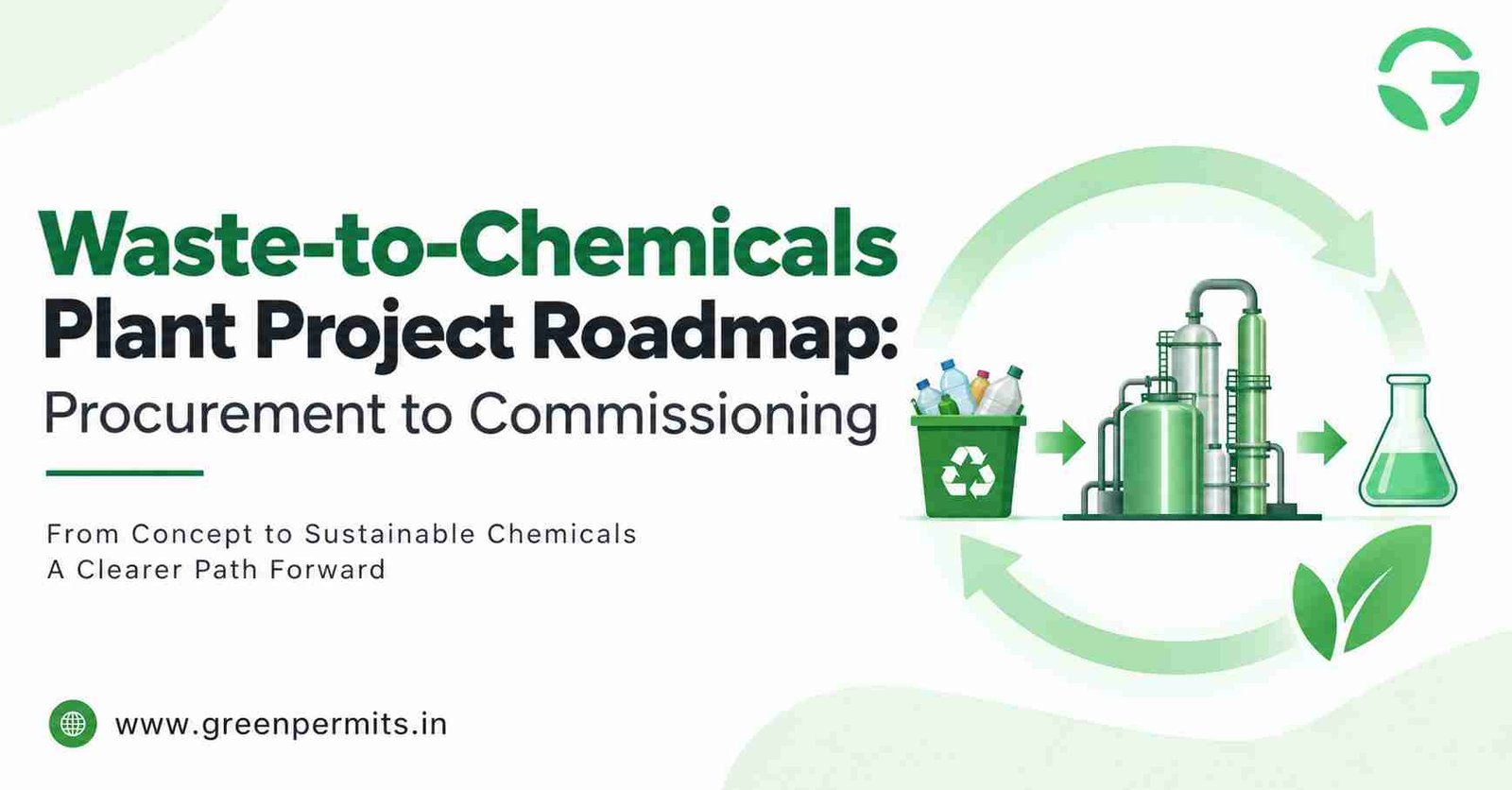
https://[a]www.greenpermits.in%2F09%2Fwaste-to-chemicals-plant-roadmap-procurement-to-commissioning%2F[/a]

📞 Get Expert Assistance for Waste to Chemicals Plant Setup
If you need help with a Waste to Chemicals Plant Project Implementation, feasibility study, DPR preparation, feedstock analysis, technology assessment or project finance, Green Permits Consulting can assist you.

🌐 Website: www.greenpermits.in

📞 Phone: +91 78350 06182

📧 Email: wecare@greenpermits.in

Book a consultation with Green Permits Consulting for Waste to Chemicals feasibility, DPR and project implementation support in India.

WhatsApp
Favicon 
www.greenpermits.in

WhatsApp

Learn how to plan a waste-to-chemicals plant in India from DPR and approvals to vendor procurement, installation, testing and commissioning.
Gefällt mir
Kommentar
Teilen
rajnandini kumari
rajnandini kumari
1 w ·übersetzen

Recycling Plant Machinery List: E-Waste, Plastic and Battery Waste

Setting up a recycling plant in India requires much more than purchasing a shredder and starting production. The machinery selected determines plant capacity, recovery efficiency, product quality, operating cost, worker safety and even the environmental approvals required for the project.

An e-waste recycling plant, plastic recycling plant and battery waste recycling plant may all be part of the recycling industry, but their equipment and processes are very different.

For entrepreneurs and manufacturers planning a recycling business, choosing machinery should therefore come after understanding the waste material, required output and proposed plant capacity.

This guide explains the major recycling plant machinery required for e-waste, plastic waste and battery waste, along with process requirements, investment considerations and common mistakes to avoid.

Conclusion
Choosing the right recycling plant machinery for e-waste, plastic and battery waste is one of the most important decisions in a recycling project.

Plastic plants typically require sorting, shredding, washing, drying, extrusion and granulation systems.

E-waste plants may require dismantling, shredding, crushing and mechanical separation equipment.

Battery recycling facilities need specialised discharge, dismantling, shredding and material-recovery systems, with advanced projects requiring additional chemical-processing equipment.

The best machinery is not always the largest or most expensive.

It is the equipment that matches the available feedstock, expected product quality, approved plant capacity and business budget.

Green Permits assists businesses and entrepreneurs with recycling plant DPR preparation, machinery planning, CTE/CTO approvals, recycling registrations and complete plant setup compliance support across India.

Website: https://www.greenpermits.in

Phone: +91 78350 06182

Email: wecare@greenpermits.in
WhatsApp
Favicon 
www.greenpermits.in

WhatsApp

WELCOME TO GREENPERMITS Are you facing issues of Complex and evolving Government regulations such as EPR/BIS and have no idea what to do? ABOUT USREAD MORE WELCOME TO GREENPERMITS Are you facing issues of Complex and evolving Government regulations s
Gefällt mir
Kommentar
Teilen
Showing 9 out of 265
  • 5
  • 6
  • 7
  • 8
  • 9
  • 10
  • 11
  • 12
  • 13
  • 14
  • 15
  • 16
  • 17
  • 18
  • 19
  • 20
  • 21
  • 22
  • 23
  • 24

Angebot bearbeiten

Tier hinzufügen


Wählen Sie ein Bild aus
Löschen Sie Ihren Tier
Bist du sicher, dass du diesen Tier löschen willst?

Bewertungen

Um Ihre Inhalte und Beiträge zu verkaufen, erstellen Sie zunächst einige Pakete. Monetarisierung

Bezahlen von Brieftasche

Zahlungsalarm

Sie können die Artikel kaufen, möchten Sie fortfahren?

Eine Rückerstattung anfordern